How to Tell If Your Marketing Partner Is Growing Your Business Or Just Managing It
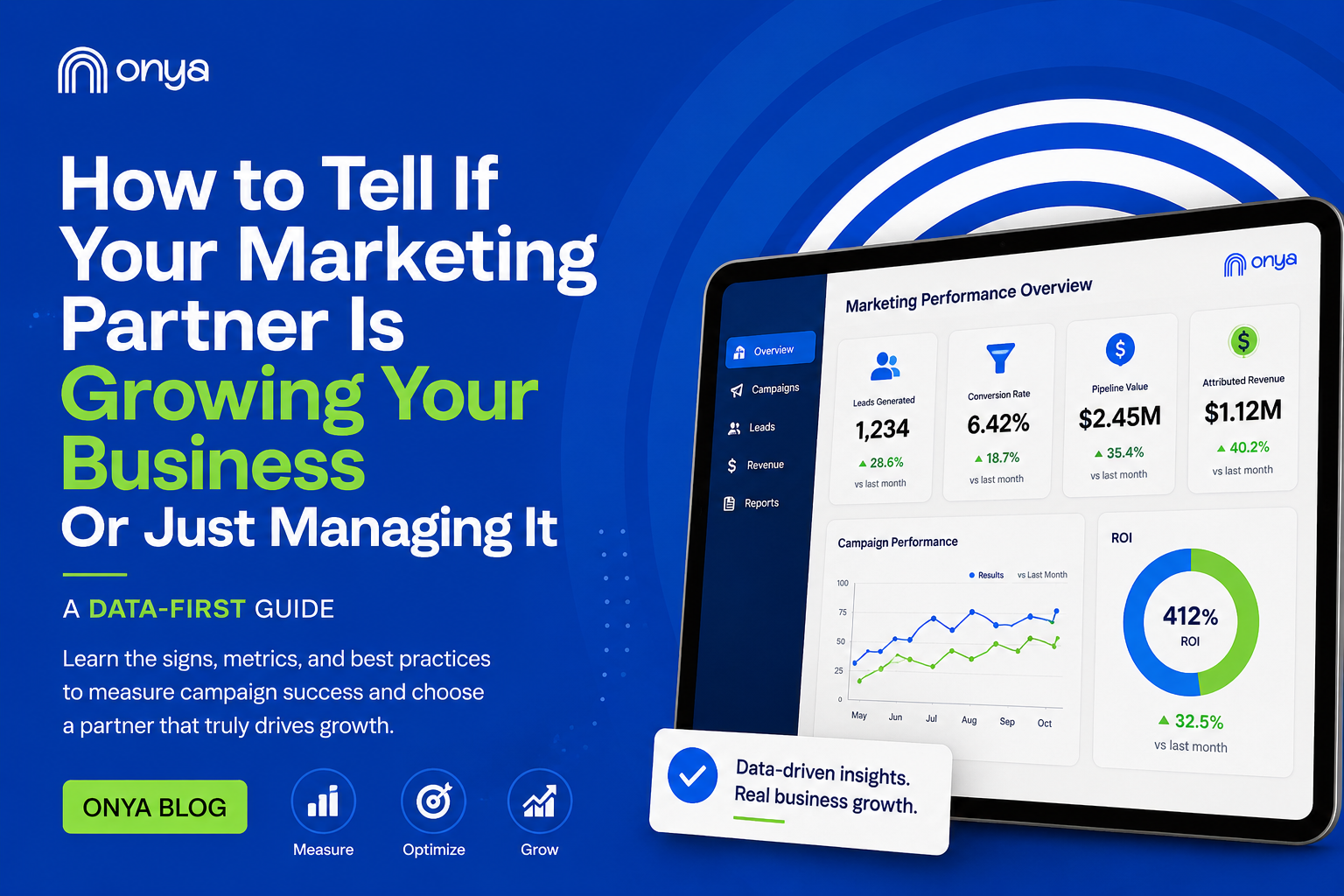
If you're reading this wondering whether your marketing partner is actually moving the needle, that question alone tells you something. A partner that's genuinely growing your business doesn't leave you guessing. You know what's working, what's not, and what's happening next, because they're telling you before you have to ask.
That's not how it goes for a lot of organizations. Reports get sent. Campaigns stay live. Meetings happen on schedule. And somehow, none of it seems to be moving the numbers that actually matter: enrollment, patient volume, qualified leads, and revenue. That's the difference between a partner managing your accounts and one actually growing your business, and it's a distinction worth being honest about.
In this blog, we're breaking down exactly how to tell the difference: the signs your partner is just keeping the lights on, how to actually measure whether your campaigns are producing results, and what to look for if you're evaluating a new marketing partner altogether.
The Difference Between Managing and Growing
Managing a marketing account means keeping things running. Campaigns stay live, reports go out on schedule, the calendar gets filled, and nothing technically breaks. It looks like activity, and on paper, it often is. But managing has a few clear tells:
- It doesn't ask why a campaign is underperforming, it just keeps it going
- It doesn't shift strategy when the market changes, it waits for the next scheduled check-in
- It optimizes for consistency, not outcomes
Growing a business looks different from the inside. It means a partner who's asking what's actually driving results and changing course the moment something isn't. A few things separate this from simply managing:
- You hear from them before you have to ask what's going on, because they already saw it and started fixing it
- Every campaign ties back to a real business outcome: enrollment, qualified leads, and revenue, not just clicks or impressions
- Strategy evolves with your organization instead of staying set once and left alone
That's the real difference: one keeps the current campaigns running. The other keeps checking whether those campaigns are actually the right approach in the first place.
Signs Your Marketing Partner Is Just Managing Your Accounts
Some of these signs are easy to miss, mostly because everything still looks like it's working. Here's what we'd flag if we saw it in someone else's account.
- The reports look fine but don't mean much. Impressions, reach, engagement, none of it tells you anything if it's not tied to enrollment, leads, or revenue.
- You only hear from them on schedule. No heads-up when something's off, just a report every month like clockwork.
- The campaigns never change. Same ads, same targeting, same channels, no matter what the results say.
- Meetings just recap the past. You hear what happened, not what's changing next.
- You're the one catching problems. If you noticed the dip before they did, that's the real red flag.
None of this means your partner is dishonest or bad at their job. It usually just means they've settled into keeping things running, and that's a very different job than growing your business. If it's been a while since anything about your strategy actually changed, it's worth asking if your agency is built for what's next.
Signs Your Marketing Partner Is Actually Growing Your Business
A marketing partner that's actually growing your business feels different day to day - not just in the results, but in how the relationship runs. You spend less time chasing updates and more time making real decisions, because the information you need is already sitting in front of you before you go looking for it.
Here's what that actually looks like in practice.
- They tell you before you ask. Something's off, they've already caught it, and they're already working on a fix, not waiting for you to notice first.
- Every metric ties back to something real. Not just clicks or impressions, but enrollment, patient volume, qualified leads, revenue, or whatever number actually moves your organization forward.
- Campaigns keep evolving. Targeting shifts, creative gets tested, budget moves toward what's working, all without you having to request it.
- Strategy conversations look forward, not backward. The focus stays on what's changing next, not a recap of what already happened.
- They tell you plainly when something isn't working. No spin, no burying it in a report, just a clear explanation and what they're doing about it.
This is what actually earns the word partner. You're not managing them. They're managing the results and making sure you always know exactly where things stand, which actually starts with clear goals set at the very beginning of the partnership.
How to Measure Partner Marketing Campaign Success
Vanity metrics feel good to look at, but they rarely tell you whether a campaign is actually working. Real measurement means tracking what happens after the click, all the way through to whether it moved your organization forward. Here's what that actually looks like.
Partner-Generated Leads
This means the specific inquiries, applications, or appointment requests a campaign can actually be traced back to by channel and by campaign, not a general uptick in website traffic. If your marketing partner can't tell you exactly how many leads came from a specific ad set last month, they're not measuring this properly.
Conversion Rate
The percentage of those leads that turn into something real: a submitted application, a booked appointment, a signed contract. This number tells you whether the leads coming in are actually qualified or just cheap to generate and expensive to chase.
Pipeline Generated
For organizations with longer decision cycles, an enrollment funnel, a healthcare service line, and a B2B sales process track how many leads are actually progressing through each stage, not just landing at the top and stalling. A healthy pipeline number shows momentum. A flat one shows leads that never went anywhere.
Revenue Attributed to Partners
The number that ties everything else together: how much actual revenue, tuition, or booked business can be directly traced back to the campaigns running. This requires real attribution tracking, not an assumption that marketing gets partial credit for whatever the sales team closed.
Campaign ROI
What came back relative to what went in, calculated against the actual cost of running the campaign, not just against ad spend alone. A campaign with a low cost-per-click can still have poor ROI if none of those clicks ever convert.
None of these metrics mean much in isolation. Leads without conversions, conversions without revenue, revenue without ROI, each tells only part of the story. A marketing partner worth keeping track of all five together and can walk you through exactly how they connect, not just report the numbers and move on. If you're not sure where your funnel is actually leaking, it helps to first understand the four important marketing funnel steps that drive real growth.
How to Choose a Digital Marketing Partner for Your Business
Choosing a marketing partner is a bigger decision than most organizations treat it as. This isn't just hiring someone to run ads or fill a content calendar.
You're handing over your audience relationship, your brand voice, and in a lot of cases, your budget for the next year to an outside team you're trusting to represent your organization well. That means when you get it right, it compounds. Get it wrong, and you're looking at months of underperformance before anyone admits something needs to change.
Best Practices for Selecting a Market Analysis Partner
Look for real industry experience. Higher ed, healthcare, and nonprofits all run on different rules. Someone who's worked in your world already knows what's at stake.
Ask how they measure success before signing anything. If the answer stops at impressions and engagement, that's a red flag.
Watch how they communicate on the first call. Vague answers now usually stay vague later.
Ask what happens when something isn't working. A good partner already has an answer.
Notice if they ask about your goals or just pitch their services. One is trying to understand you. The other is trying to close you.
At Onya, this is the exact standard we hold ourselves to. We built our process around being the kind of partner that actually earns its place, one that brings what a reliable digital marketing agency should genuinely add to your organization, real strategy, real accountability, and results you don't have to chase down yourself.
Conclusion
What actually separates a manager from a growth partner shows up in the details: whether the numbers on those reports connect to something real, whether you hear about a problem before you have to ask, and whether the strategy keeps moving or just repeats itself month after month.
If you recognized your own marketing partner in the "just managing" signs more than the "growing" ones, that's worth paying attention to. A marketing partner that's simply keeping things running isn't doing anything wrong, exactly, but it's not doing what you're actually paying for either.
At Onya, growth is the whole point. Our process, Assess, Strategize, Execute, Refine, exists specifically so you're never left wondering what's working or what we're doing about what isn't. Choosing the right partner is only the first step; planning for long-term success is what actually determines whether that choice keeps paying off.
If you're ready to find out whhttps://www.onyamark.com/at your marketing could actually be producing, let's talk.
Frequently Asked Questions (FAQs)
1. How long does it take to tell if a marketing partner is actually growing my business?
Most organizations start seeing clear signals within 60-90 days, enough time for a full campaign cycle to run and for patterns in leads, conversions, and communication to become visible.
2. Should I switch marketing partners if I'm seeing "managing" signs, or try to fix the relationship first?
It depends on whether the issues come from execution or communication. A direct conversation about goals and reporting expectations is worth trying first, but if nothing changes after that, it's a sign the partnership has hit its ceiling.
3. What's a reasonable amount of communication to expect from a marketing partner?
Beyond scheduled monthly reports, you should hear from your partner proactively whenever something significant shifts, a campaign underperforming, a major opportunity, or a change in strategy, not just when you reach out first.
4. Do smaller organizations need the same level of reporting as larger ones?
Yes, though the complexity may differ. Even a smaller budget deserves clear visibility into what's working and what isn't, since the stakes of wasted spend are often higher for smaller organizations, not lower.
5. Can a marketing partner grow my business without a big budget increase?
Often, yes. A lot of growth comes from better targeting, stronger creative, and smarter budget allocation within an existing spend, not simply spending more.