What does a digital marketing agency do for small businesses?
Most small business owners eventually choose between three options: build an in-house team, hire freelancers, or bring in an agency. In-house isn't affordable yet for most, and freelancers get hard to coordinate as the workload grows.
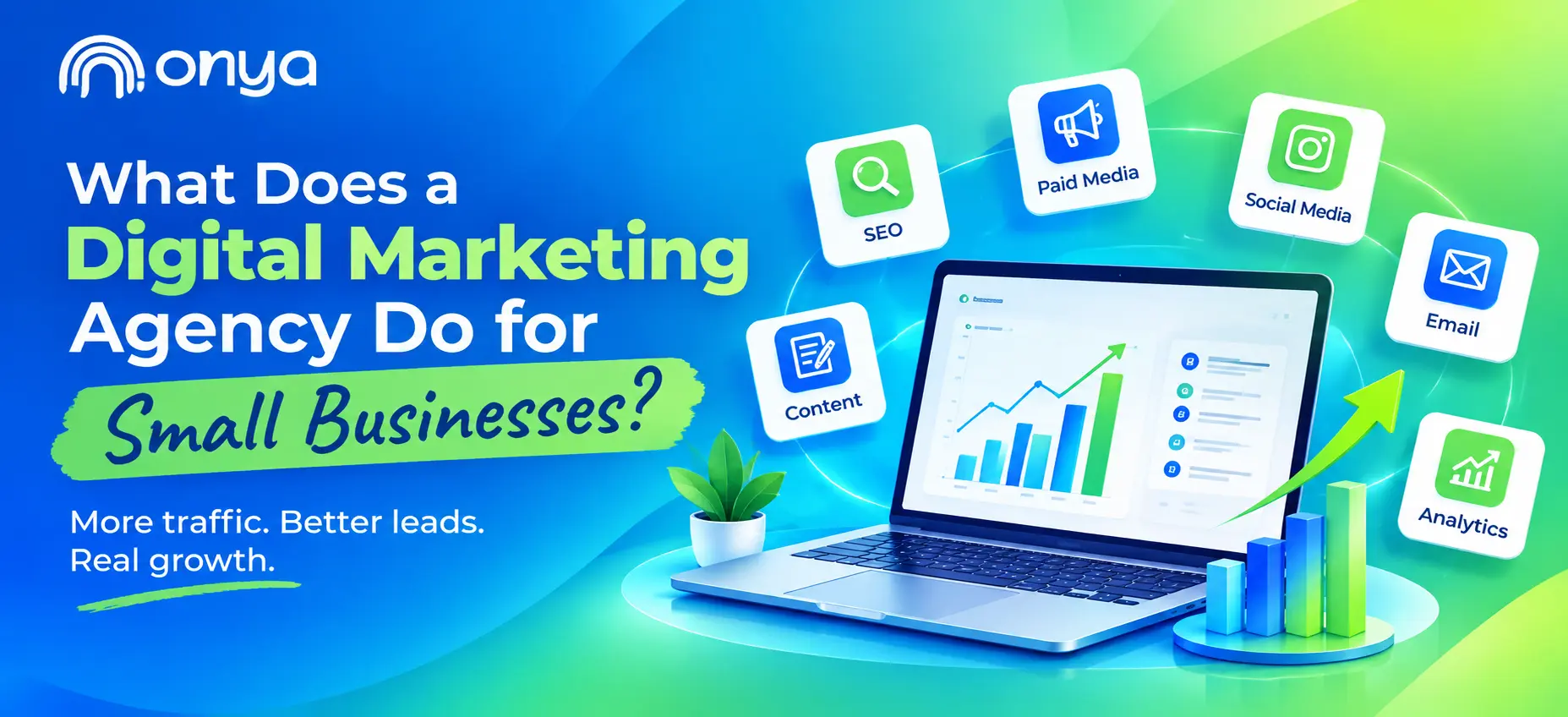
In this case, an agency may help solve exactly that problem that small businesses may encounter. Digital marketing agencies for small businesses help in a way that a freelancer or in-house team may not. They run SEO, paid media, social, content, and email as one connected system instead of five separate jobs. This matters particularly for small businesses that can’t yet justify a full internal marketing team.
If you’re looking to hire a digital marketing agency for your small business, here’s what you need to know about, including what a full-service digital marketing agency actually does, which services are worth paying for, and how to spot a genuinely good agency instead of one running on buzzwords.
Quick Answer - What Does a Digital Marketing Agency Actually Do?
A digital marketing agency helps businesses grow their online presence. They help manage SEO, paid advertising, social media, content, email, and analytics, either as standalone services or as one integrated strategy.
- What it replaces: a full in-house marketing department, minus the fixed salary cost
- How it's usually structured: one team handling strategy, execution, and reporting together – not split across freelancers
- Services covered: SEO, AEO, GEO, paid media, social, content, email, and web design
- The US market right now: $56.9 billion in 2026, reflecting continued demand for digital advertising services.
What Is a Digital Marketing Agency?
A digital marketing agency is a team of specialized people who help grow your business by strengthening your online presence. They manage everything from SEO to content marketing to running paid ads, optimizing each one for better results over time.
Small businesses choose agencies because hiring that same range of specialists in-house costs far more than most can justify early on. On the other hand, a freelancer usually does one job well – writing ad copy, for example, or managing a single social account. But an agency does all of these jobs at once.
Core Services of a Full Service Digital Marketing Agency
A full-service digital marketing agency typically works across seven core areas, and understanding what each one does makes it easier to know what to prioritize first.
Search Engine Optimization (SEO)
Google alone accounts for 63.41% of all US web traffic referrals, more than every other channel combined. Yet most small businesses haven't caught up to that reality: only about 55% currently invest in SEO, and among those who do, most still don't invest consistently. AI search results have added a new layer too, which is part of why agencies now pair SEO work with strategies for AI-driven search, something covered in more depth in how AI has actually changed agency work.
Pay-Per-Click Advertising (Google Ads/Meta Ads)
PPC delivers immediate visibility while SEO builds over months, which is why most agencies run both together rather than picking one. Search advertising adoption among small businesses has grown to 45%, up from 40% the year before, and it's one of the tactics SMBs report being most satisfied with.
Social Media Marketing & Management
Beyond posting, social media marketing and management covers strategy, community management, and paid social campaigns. Short-form video now leads as the top content format, used by 60% of marketers – a shift that's changed what "good" social content actually looks like.
Content Marketing & Copywriting
Content marketing isn't losing ground; it's converting better than ever. It costs 62% less than outbound marketing and generates leads three times more likely to convert. Small businesses specifically are 23% more likely to see ROI from blog posts than larger companies, making it one of the more cost-effective services for smaller budgets.
Email Marketing & Marketing Automation
Email marketing isn't dead. It remains one of the highest-ROI channels available. 50% of US B2B marketers rank it as their single most effective channel, and the average return sits around $36 for every $1 spent. Automation is what makes it scalable for a small team, handling welcome sequences and follow-ups without manual effort.
Website Design & Development
Every other service sends traffic to one place: the website. If it loads slowly or buries the next step, that traffic converts nowhere. CRO work, testing layouts, forms, and calls to action, turns existing visitors into leads without spending more to get them.
Analytics, Reporting & Strategy
This is what tells you if the other six services are actually working. Without it, the budget gets allocated on gut feeling. With proper reporting, decisions follow the data: which channel drove the lead, what it cost, and where the next dollar should go.
What Are the Types of Digital Marketing Agencies?
Different agencies specialize in different things. Knowing what each one actually does helps you choose the right digital marketing agency for your business.
Full-Service Digital Marketing Agency
One team, every channel, SEO, ads, social, content, email, web design, working from a single strategy. If you'd rather not manage five different vendors yourself, this is the option built for that.
Performance Marketing Agency
Paid ads are the whole focus here, mainly Google and Meta, with every dollar tracked against what it brings back. Makes sense when you need results now and your SEO or content is already someone else's job.
SEO-Focused Agency
Organic search only: fixing technical issues, building content that ranks, and earning links. You'll wait longer to see traction, but the traffic it builds keeps showing up long after you stop paying for it.
Social Media Agency
Runs your platforms, plans your content, manages the community, and sometimes handles paid social on top. Works well when people buy based on what they see – restaurants, clothing brands, anything visual.
Content Marketing Agency
Writes the blogs, scripts the videos, and builds the material that earns trust before someone buys. If your product needs explaining first, this is usually where B2B and high-ticket businesses turn.
Whichever type you choose, the real question comes after you hire them: is it actually working? These are the metrics CEOs actually look at to answer that – not vanity numbers like likes or impressions.
The USA Digital Agency Market in 2026
The USA digital agency market in 2026 stands at $56.9 billion, up from $53.4 billion the year before. Growth hasn't been a one-year spike either; it's climbed at a 7.5% compound annual rate since 2021.
- Market size: $56.9 billion in 2026
- Year-over-year growth: up from $53.4 billion in 2025
- 5-year CAGR: 7.5% between 2021 and 2026
- Number of agencies: roughly 100,000 operating across the US
Demand is still rising on the client side too. Sixty percent of small businesses plan to increase marketing spend in 2026, and most marketers report entering the year with confidence rather than caution. That growth comes with more scrutiny attached, and businesses are asking harder questions about ROI and expecting agencies to prove results – not just activity.
How to Choose the Right Digital Marketing Agency for Small Business
The agency search usually starts with a Google search and ends with five nearly identical pitch decks. What separates a good hire from a costly mistake rarely shows up on the pitch. It shows up in the details most businesses forget to check.
- Know what they actually specialize in. A generalist agency juggling every service and a true full-service agency running them as one strategy are not the same hire, and the difference shows up fast once campaigns launch.
- Judge the portfolio – not the pitch. Anyone can talk convincingly for an hour. Past work under pressure tells a more honest story. This breakdown of what to actually look for in a portfolio is worth reading before any contract gets signed.
- Test how they explain results. An agency that hides behind jargon when a number looks bad is telling you something. One that explains the number plainly, good or bad, is telling you something better.
- Confirm real experience in your industry. An agency that's already solved your kind of problem skips the expensive learning curve most businesses end up paying for.
This is the bar Onya holds itself to with every client it takes on: real specialization, a portfolio that earns the claim, and reporting that never needs a translator. Anyone comparing agencies right now would do well to measure against exactly that.
Conclusion
A digital marketing agency for small businesses is only as good as the results it can prove, in plain numbers – not polished decks. Onya is a full-service, white-label digital marketing agency built to deliver exactly that for small businesses across every channel that matters. See what Onya can build for your business.
Frequently Asked Questions (FAQs)
How much should a small business budget for digital marketing?
Most small businesses spend between $2,500 and $12,000 a month, depending on services and goals. Start with what one or two priority channels cost, not a blanket "marketing budget."
How long does it take to see results from a digital marketing agency?
Paid ads can show results within weeks. SEO and content typically take three to six months to build real traction.
Can I hire an agency for just one service instead of everything?
Yes. Specialized agencies exist exactly for this; hire one for SEO or paid ads alone if that's all you need right now.
Is it cheaper to hire an agency or build an in-house marketing team?
An agency is almost always cheaper upfront, since you're not paying full-time salaries for five specialists. In-house only pencils out once you're big enough to keep them all busy.
What happens if I'm not happy with an agency's results?
Check the contract terms before signing; most reputable agencies offer monthly terms or a clear exit clause. If results consistently miss the mark, that's a sign to switch, not wait it out.