Email Marketing For Small Business Isn’t Dead — AI Search Just Made It More Important
People have been calling email marketing dead for years. Social media took the crown, then AI search tools showed up promising to replace it too. Yet small businesses that rely on email marketing keep seeing it outperform nearly every other channel they invest in, often by a wide margin.
The truth is that the noise around email comes from platforms competing for ad budgets - not from the actual performance data. Open rates fluctuate, inboxes get crowded, and trends shift, but the fundamentals haven't changed. A list of people who chose to hear from you is still one of the most valuable assets a small business can build. It’s one you actually own, unlike a following on a platform that can change its algorithm overnight.
At Onya, we have closely studied what the data really shows about email marketing for small businesses, why it still works even against newer channels, and how to build a strategy that fits a small team's time and budget. This blog explains what we actually found!
Is Email Marketing Dead? What the Data Actually Says
More than 4.5 billion people use email worldwide, and about 93% check email every single day. 58% of them say email is the first thing they check online each morning. 59% of consumers say email has influenced their buying decisions, and 81% of small businesses use email as their primary customer acquisition channel.
This data isn’t just numbers; it’s proof that email marketing is still relevant, and hundreds of thousands of (big or small) businesses use it to
- Build lasting customer relationships
- Drive more sales and repeat purchases
- Reach customers directly without relying on algorithms
- Promote products, services, and special offers
- Increase customer loyalty and retention
Businesses that rely on algorithms and products/service promotion through social media are usually the ones complaining that email marketing is dead. They compete for limited attention by constantly showing up on feeds, which a normal user can actually process. Social feeds are crowded, ads are getting more expensive, and algorithms decide who sees what on any given day. But emails skip all of that!
How Email Marketing Still Works for Small Businesses
One of the most compelling truths about email marketing for small businesses is that they don’t need a big budget to work - just a list and a little consistency. Unlike paid ads or social media, emails don’t get pricier every year or fight with an algorithm that constantly changes on a whim. Here are more reasons why email marketing is not dead; it’s still working for many businesses.
Costs less than paid ads
For every dollar a business puts into email marketing, it typically gets back around $36, putting its return on investment at roughly 3,500%, according to Litmus's research on email marketing ROI. Compared to social media, email doesn't just do a bit better at bringing in new customers; it does dramatically better, coming in at 40 times more effective for customer acquisition.
You own your list
Half of your hard-earned social media followers can be declared bots and vanish overnight. The algorithm can stall your reach without warning, suspend your account for reasons that are never quite clear, or shut it down entirely, taking years of built-up audience with it. An email list doesn't work that way. It belongs to the business entirely, and every subscriber on that list chose to be there. No update, policy change, or outage can take that relationship away.
Drives repeat business
Winning a new customer almost always costs more than keeping one a business already has. Email is built for the second half of that equation. A well-timed message - whether it's a reminder, a restock alert, or a simple discount - gives past customers a reason to come back without the business having to compete for fresh attention. Over time, this turns one-time buyers into repeat ones and repeat buyers into the kind of steady revenue small businesses actually depend on.
Reaches people directly
There's no algorithm standing between a business and its audience with email. A message sent lands in an inbox, not somewhere buried in a feed that decides who sees what and when. That directness matters more than it sounds. It means a small business doesn't need a huge following or a lucky bit of engagement to get noticed. It just needs a list and something worth saying, and the message gets through.
Works at any size
Email advertising for small business doesn't require scale to be effective. A business with a few hundred subscribers can see real results with the right message, the same way a much larger list can. A local bakery announcing a new seasonal item, or a B2B firm relying on b2b email marketing services to stay in front of a handful of key accounts, doesn't need thousands of contacts to make an email worthwhile. What matters is relevance, not size, which makes email one of the few channels where a small business isn't at a disadvantage against a much bigger one.
How AI Is Changing How Campaigns Are Built
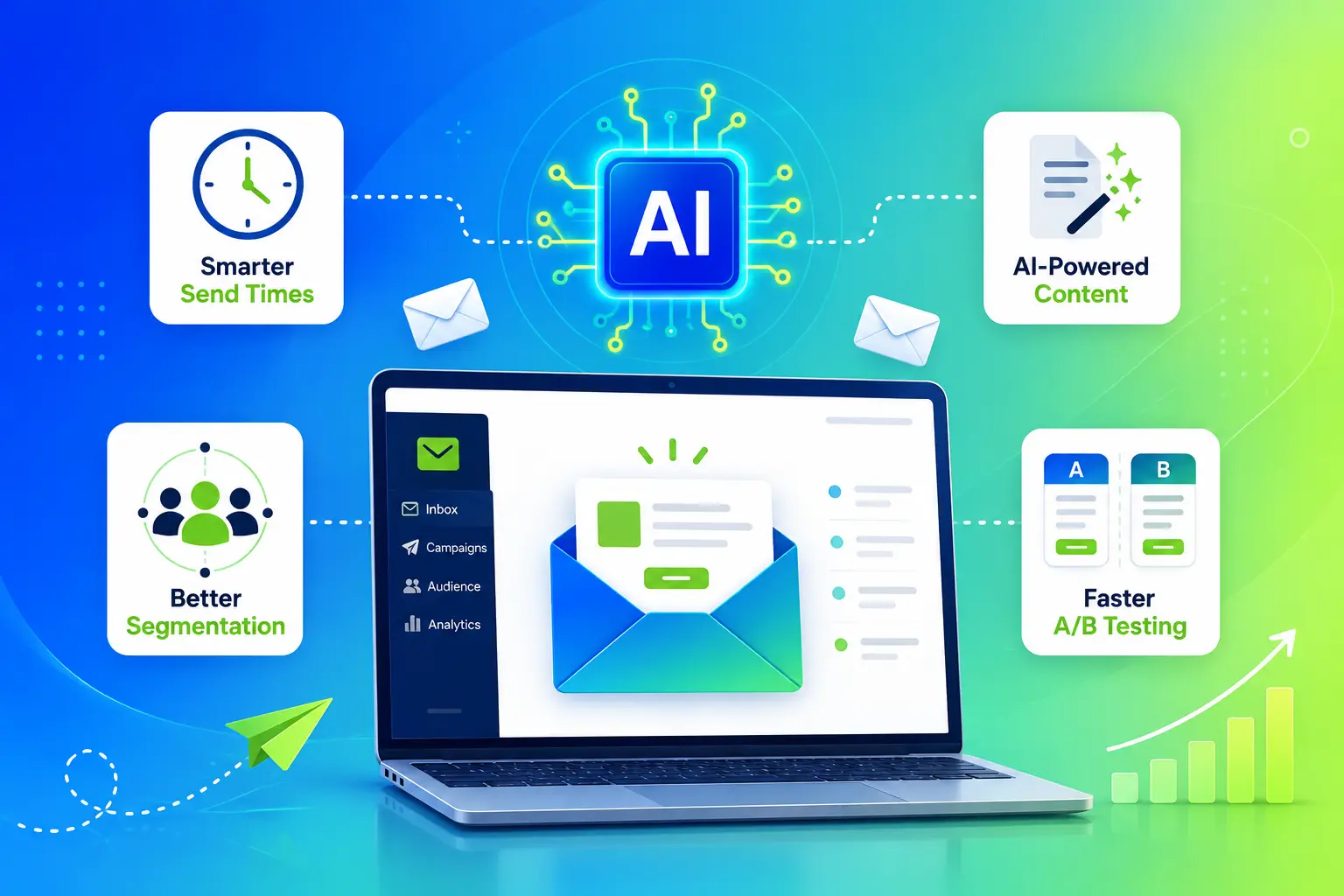
Ever since AI started showing up inside email platforms, small businesses have been left wondering how much of the work it's actually supposed to take off their plate. Generative AI in email marketing for small businesses generally works in two layers. One layer looks backward, analyzing past customer behavior, like opens, clicks, and purchase history, to spot patterns. The other layer uses those patterns to actually generate something new: a subject line, a content block, a product recommendation.
Together, they handle a lot of the manual lifting that used to eat up a marketer's week. Here's where that shows up in real campaigns:
Smarter send times - Instead of picking one blanket time for an entire list, AI looks at when each subscriber has actually engaged in the past and times the send around that
Faster A/B testing - Generative AI makes testing subject lines, content blocks, and layouts together in the same round, cutting down the number of separate tests needed to find what works
Content variations at scale - A single email can be turned into several versions tailored to different customer segments in a fraction of the time it would take to build each one by hand
Sharper segmentation - AI can spot patterns in customer data that aren't obvious at a glance, making it easier to group subscribers by what they actually respond to, not just basic demographics
Ultimately, the businesses getting the most out of AI right now aren't handing it the keys. They're using it to move faster on decisions they've already made, while keeping a human hand on the tone, the timing, and the judgment calls that still make a brand feel like a brand.
How Email Marketing is the Most Underrated Channel in an AI-Search World
Google's AI Overviews are changing how people find information, chatbots answer questions before anyone clicks a link, and small businesses are scrambling to stay visible in that shift. Email marketing barely gets mentioned in that conversation. That's exactly why it deserves attention.
What AI search cannot touch is a list that a business owns. AI Overviews decides what gets shown based on an algorithm no business controls, but that algorithm has no say over a business's email list. It's a direct line to people who already said ‘yes,’ and no search update or AI summary can take that away.
SEO and AI search visibility is a top priority for most businesses, but a business betting everything on being found is ignoring the channel built to keep people found after they've already shown interest.
While competitors chase visibility in an increasingly AI-driven search landscape, businesses building an email list are holding onto something more stable: a direct relationship no algorithm can touch. That's the real case for email marketing for small businesses. It's not competing with AI search; it's simply not affected by it, and that kind of stability is worth more than it looks.
How to Use Email Marketing to Grow Your Business
Most small businesses trying to win through email marketing aren’t missing the tools; they’re missing the framework. Because understanding email marketing isn’t the same as building a program that consistently delivers maximum ROI, and these five ways to maximize ROI from email marketing show exactly how to get there.
Building Your List the Right Way
A smaller list of people who actually want to hear from a business will always outperform a large one full of contacts who never asked to be there. Growing that list organically (through lead magnets, sign-up forms, and gated content) usually takes longer, but every subscriber it brings in actually wants to be there.
A discount code, a useful guide, or early access to something worth having gives people a real reason to opt in, instead of just filling a form because a checkbox was already ticked.
Segmenting Your Audience
Sending the same email to your entire list, regardless of where someone stands with your brand, is where relevance goes to die. This is where segmented campaigns consistently pull higher open rates than unsegmented ones. In fact, basic segmentation (such as purchase history, engagement level, or how someone signed up) makes a real difference in increasing engagement and driving higher conversions.
A first-time subscriber and a repeat customer shouldn't get the same email, and segmentation is what keeps that from happening.
Automating Without Losing the Personal Touch
Automation is what makes this sustainable for a small team without extra hands to spare. Welcome sequences, abandoned cart reminders, and re-engagement emails run in the background once they're built, reaching people at exactly the right moment: a new subscriber's first week, a cart left sitting for two days, a customer who's gone quiet, without anyone manually hitting send. The catch is that automation has to still sound like a person wrote it. A welcome email should read as an introduction, warm, specific, a little personal, not a form letter with a name merged into the greeting.
Once the basics are working, here's how to step up your email marketing game for ideas on refreshing content and layout even further.
Conclusion
Email marketing still delivers one of the highest returns of any channel available to small businesses, and that's before accounting for what AI is doing to make it faster and more personal to run. The businesses treating it as an afterthought are the ones missing out. The ones building their list with intention, segmenting with purpose, and automating without losing their voice are the ones seeing real growth from it.
Getting there takes more than knowing the fundamentals. It takes a strategy built around an actual business, its actual customers, and a team that can execute on it consistently. That's where Onya comes in. Onya builds strategy around outcomes that actually matter, not activity that just looks good on paper. That covers everything from email and creative to advertising and social.
If the current email strategy has plateaued, or there isn't one at all, book a call with Onya and find out what a well-run marketing program could actually do for the business.
Frequently Asked Questions (FAQs)
What are the benefits of email marketing over social media?
Email gives you direct access to your audience without depending on platform algorithms. It also delivers better personalization, higher engagement, and stronger customer retention.
What types of emails should small businesses send?
Small businesses should send welcome emails, newsletters, promotional offers, educational content, and follow-up emails to keep customers engaged and informed.
What is email segmentation, and why is it important?
Email segmentation means grouping subscribers based on their interests, behavior, or purchase history. It helps you send more relevant emails that improve open rates, clicks, and conversions.
How can a small business build an email list?
Offer something valuable like a discount, free guide, or newsletter in exchange for an email address. Add signup forms to your website, landing pages, and social media.
What is a good email open rate for small businesses?
A good email open rate is typically between 20% and 30%, although it varies by industry. Higher open rates usually indicate relevant content and a healthy email list.