What Strategies Improve Brand Visibility in AI Search Engines?
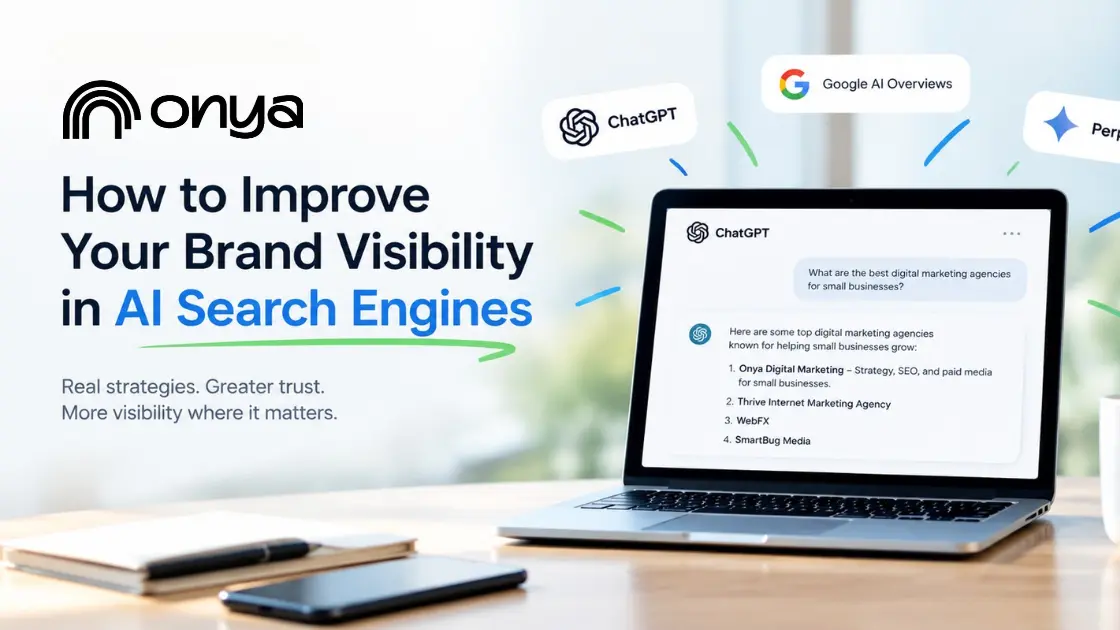
Search has fundamentally changed the way people find information. Nowadays, AI-powered engines like ChatGPT, Google AI Overviews, and Perplexity are no longer returning a list of links. They are generating direct answers, pulling from sources they’ve determined to be credible.
The brands appearing in those responses tend to get more visibility and they’re not even those within the highest ranking searches on Google. They’re the ones AI has learned to trust and that’s the reason why it improves their brand visibility in AI search engines. For organizations that have invested years building their SEO presence, this shift carries real consequences. The strategies that earned visibility in traditional search don’t automatically carry over to AI search.
If your brand isn’t showing up when AI engines answer questions your audience is asking, this blog is for you! It covers what improves brand visibility in AI search engines and what you can do about it.
Quick Answer: What Improves Brand Visibility in AI Search Engines?
AI engines decide what to cite based on a combination of trust signals, content structure, and technical access. Brands that show up consistently in AI-generated answers tend to score well across the following factors:
- Brand authority and consistency
- Direct-answer content structure
- Trusted website mentions
- Topic depth and coverage
- Website crawlability
These factors don’t work in isolation. A brand with strong authority but poor crawlability still won’t get cited, and well-structured content without trust signals behind it falls flat too. Building all five together is what actually moves visibility.
Why Brand Visibility in AI Search Engines Matters in 2026
AI search is no longer something organizations can afford to watch from a distance. A growing share of people are getting answers directly from AI engines without visiting a single website. For organizations that depend on organic search to drive inquiries, that shift is already showing up in their numbers.
Here is why it matters:
- AI-generated answers are replacing traditional search results for a significant and growing share of queries
- Brands AI doesn’t recognize don’t get cited regardless of how strong their traditional SEO is
- Competitors optimizing for AI visibility are already showing up in the answers your audience is reading
- Organic click-through rates are falling as more people get what they need directly from AI responses
- Visibility lost to AI search is harder to detect because it doesn’t show up as ranking drop in traditional analytics
The staggering part is your rankings can look stable while your actual visibility quietly disappears. If your inquiries have slowed down without an obvious cause, it’s worth askingwhy your AI search visibility may have dropped before assuming the problem is somewhere else.
How AI Search Engines Work Differently from Traditional Search
Traditional search hands you a list of links and lets you decide. AI search skips that step. It reads across multiple sources, decides what’s accurate and relevant, and hands you one synthesized answer, often with no click required at all.
That difference changes what “ranking well” actually means.
Ultimately, it’s important to note that ranking #1 in traditional search doesn’t guarantee you’ll be cited in an AI-generated answer. The two systems are solving different problems, which is why it’s possible to still look strong on paper — good rankings, steady traffic — whilenot actually generating the inquiries that traffic should bring. Brand visibility in AI search needs its own strategy, not just a better version of traditional SEO.
Best Practices for Improving Brand Visibility in AI Search
Improving brand visibility for small online businesses in AI search isn’t about gaming a new algorithm. It’s about earning something simpler: a reason for AI engines to trust and cite your brand in the first place. That comes down to how you structure content, build authority signals, and shape your digital presence, all in ways these systems can actually read, verify, and pull from.
Here are some strategies that can help improve brand visibility in AI search engines.
Strengthen Brand Authority
AI engines don’t just grab the most optimized page; they pull from the source they trust the most. And that trust comes from signals that prove you’re credible and established.
Here are a few things that might contribute towards strengthening the brand’s authority.
- Keep your business name, address, and details consistent everywhere online
- Earn mentions and backlinks from credible, industry-relevant sites
- Build a steady base of genuine reviews on platforms AI engines actually crawl
- Add schema markup so AI systems can read exactly what your business does
The stronger these signals are, the more likely AI search is to treat your brand as worth citing.
Create Direct-Answer Content
AI engines favor content that gets straight to the point. If a reader has to dig through long intros to find an answer, AI skips it for something clearer.
Here’s how to structure that:
- Open sections with a direct answer, then explain the reasoning after
- Use clear headers that match how people actually ask questions
- Keep answers concise enough to be lifted and quoted as-is
- Break down complex ideas into short paragraphs or bullet points
Content built this way doesn’t just read better; it’s easier for AI engines to extract, understand, and cite accurately.
Earn Trusted Website Mentions
AI engines weigh who’s talking about your brand almost as much as what you say about yourself. A mention on a credible, relevant site signals that others vouch for you, not just your own marketing.
Here’s how to build that:
- Pursue coverage, guest posts, or partnerships with reputable industry sites
- Get listed in trusted directories specific to your industry
- Build relationships with publications your audience already reads
- Prioritize relevance and credibility over sheer volume of mentions
The more consistently trusted sources reference your brand, the more confidently AI engines can validate and cite it.
Build Topic Clusters
Isolated blog posts rarely convince AI engines of anything. What works is depth — a set of pages that cover a topic from every angle a reader might approach it from.
To build a cluster that works:
- Pick one core topic that matters to your business
- Write a solid pillar page covering it broadly
- Create separate pages for the smaller, specific questions underneath it
- Link each supporting page back to the pillar
Over time, this builds something AI engines can’t ignore: a site that clearly knows its subject inside and out.
Improve Website Crawlability
Last but not least, you can write the best content in your industry and it still won’t show up anywhere if AI engines can’t reach it. This is the unglamorous part of the work, but it’s non-negotiable. Start with your robots.txt file. A single misconfigured line can block pages you actually want indexed. Then look at your internal links. Broken paths and endless redirect chains slow crawlers down or stop them completely. Site structure matters too. If a page is buried five clicks deep, don’t expect it to get found easily. And speed still counts. Pages that load slowly or render poorly on mobile lose out, even when the content itself is strong.
Can AEO Actually Improve Your Website's Visibility in AI-Driven Search Engines?
Yes, and the reason is straightforward. AI engines aren’t ranking pages; they’re selecting answers. AEO works because it gives them exactly what they’re looking for: content that’s clear, well-structured, and backed by real authority. Get that right, and your odds of being cited go up measurably.
What it won’t do is rescue a site with no real substance behind it. AEO sharpens what’s already strong; it doesn’t manufacture credibility out of nothing. That’s also whyAI hasn’t replaced agencies so much as exposed the ones that were coasting on outdated tactics. The agencies still delivering results are the ones who adapted. Onya built its AEO approach around that same principle: fundamentals done right, not shortcuts dressed up as strategy.
Conclusion
AI search isn’t a trend to watch from the sidelines; it’s already reshaping how your audience finds answers and whether your brand shows up in them at all. The organizations that take this seriously now, by strengthening authority, structuring content for direct answers, and fixing the technical fundamentals, are the ones AI engines will trust enough to cite later. This isn’t something to figure out through trial and error while your visibility quietly slips away.
If you’re ready to build a real strategy instead of guessing at one, Onya can help, as a full-service digital marketing agency, we build the authority, content, and technical foundation that gets brands seen in search results and in AI-generated answers alike.Book a call and let’s talk about what that looks like for you.
Frequently Asked Questions (FAQs)
How is AEO different from traditional SEO?
SEO ranks pages in search results; AEO focuses on getting content cited inside AI-generated answers. Both matter, but AEO prioritizes clarity and trust over keyword rankings alone.
How long does it take to see results from AI search optimization?
Most brands see early citation gains within 2–3 months, with stronger results by 6 months. Timelines depend on your starting authority and content quality.
Which AI search engines should I optimize for?
Google AI Overviews, ChatGPT, Perplexity, and Microsoft Copilot are the most influential right now. Building real authority and clarity improves visibility across all of them.
Do backlinks still matter for AI search visibility?
Yes. Backlinks from credible, relevant sites remain one of the strongest trust signals AI engines use to decide what’s worth citing.
How do I know if my AI search visibility is improving?
Track branded mentions in AI tools, monitor referral traffic from AI platforms, and test your target queries to see if your content gets cited.