Google Ads vs. Meta Ads: Which is Better Google Ads or Meta Ads?
Every business eventually asks the same question: Google ads or Meta ads? Most treat it like a coin flip, pick one, hope it works, switch if it doesn't. That approach wastes budget before it ever has a chance to prove anything.
The real question isn't which platform is better. It's where your customer actually is when they're ready to buy. Google Ads catches people already searching for a solution, someone typing "emergency plumber near me" is close to making a decision right now. Meta Ads works earlier than that, putting your business in front of someone before they've started looking, using behavior and interest data instead of a search query. Different jobs, different platforms, and the businesses that get this wrong usually find out the expensive way.
This guide breaks down how each platform (Google Ads and Meta Ads) actually works, what the key difference between them is, and how to figure out which one deserves your budget's attention.
Understanding Google Ads and Meta Ads
Before comparing Google ads vs. Meta ads costs or results, it helps to know what each platform is actually built to do.
Google Ads operates on intent, meaning it shows up when someone actively searches for something, a product, a service, an answer. Google places your ad in front of that existing demand. The person searching already knows what they want; Google Ads just makes sure your business is the one they find.
Meta Ads work the opposite way. It relies heavily on behavior and interest instead of a search query. Meaning rather than waiting for someone to look for something, it uses data, demographics, browsing patterns, engagement history to predict who's likely to want it before they've gone searching. Search captures demand that already exists.
Meta creates demand that doesn't exist yet, which is why most effective ad strategies eventually use both, just not necessarily starting with the same one.
How Google Ads and Meta Ads Actually Work
Understanding the difference matters because these two platforms don't just charge differently, they demand different kinds of effort too.
How Does Google Ads Work?
Google Ads runs mostly on cost-per-click. This means you pay when someone actually clicks - not just for showing up on the page. However, getting there takes ongoing keyword research, bid management, and constant refinement.
How Does Meta Ads Work?
Meta Ads asks for a different kind of work: less keyword strategy, more time spent creating content people actually want to stop and watch. It runs on cost-per-thousand-impressions, so you're paying for reach whether anyone clicks or not. And the real effort shifts toward creativity, testing images, videos, and messaging repeatedly to find what actually stops someone mid-scroll.
That's exactly why creative matters so much more here than on Google. Meta isn't capturing a search that already exists, it's creating interest that wasn't there yet. When your business understands this, the key differences start to make a lot more sense. Our deeper look at why Facebook ads are still the most powerful advertising channel breaks down exactly how that targeting and creative engine performs in practice.
Google Ads vs. Meta Ads: Key Differences You Need to Know
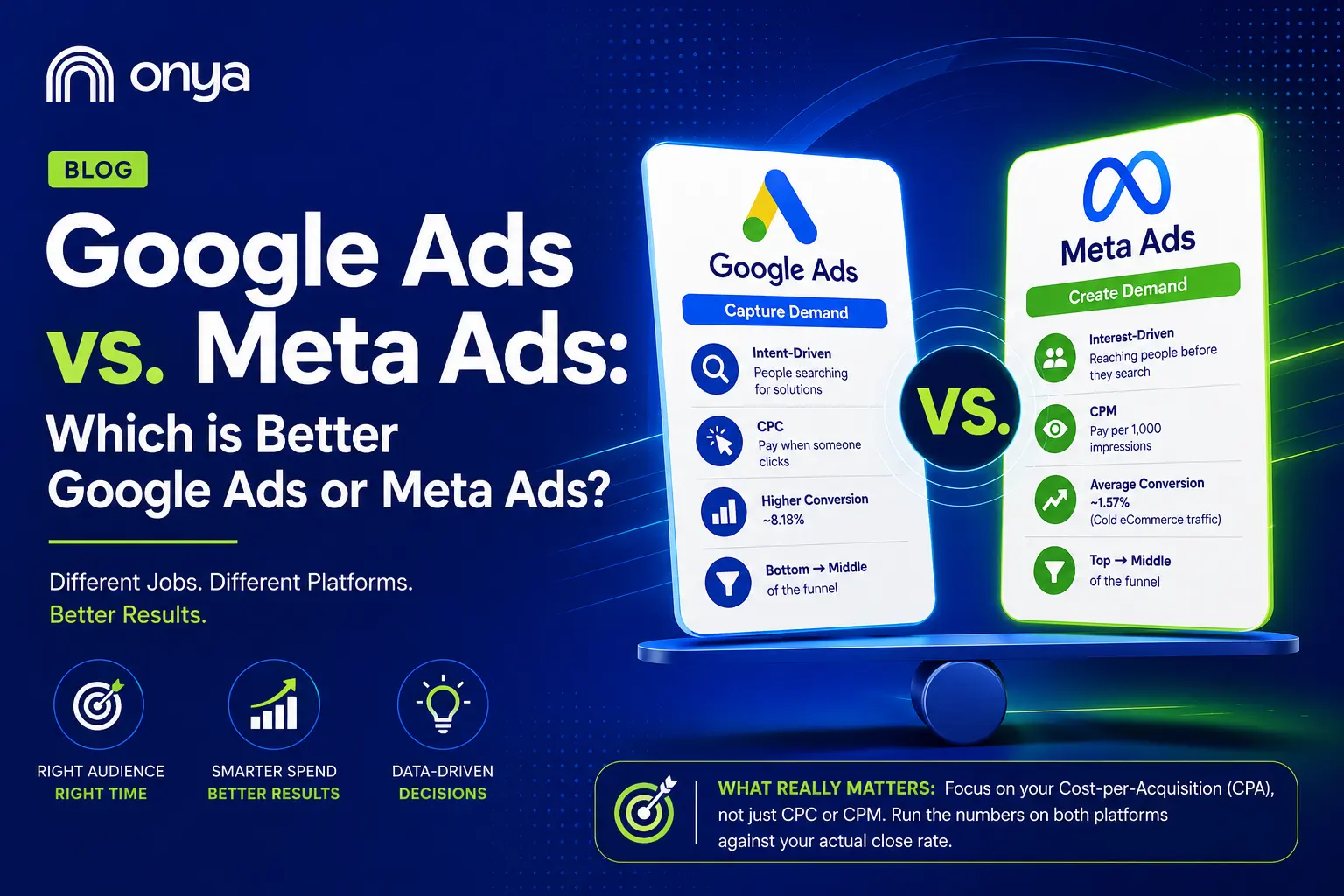
Google ads and Meta ads - the two platforms don’t just cost differently. They measure success differently, target differently, and reward different kinds of effort. Here's how they actually stack up heading into 2026.
GOOGLE ADS
Capture Demand
CPC: Pay when someone clicks
Targeting: Keywords & search intent
Conversion: ~8.18%
Best at: Capturing people already looking
Funnel: Bottom → Middle
Ideal for: Local services, B2B, high-intent buyers
META ADS
Create Demand
CPM: Pay per 1,000 impressions
Targeting: Demographics, interests & behavior
Conversion: ~1.57% cold ecommerce traffic
Best at: Discovery & audience building
Funnel: Top → Middle
Ideal for: Ecommerce, visual products, brand awareness
Best visual choice: Use the second format if this is for a social media post or presentation, and the first format if it's for a blog article.
The number that actually matters here is cost-per-acquisition, not the CPC or CPM figures on their own. Run the math on both platforms against your actual close rate before assuming the lower sticker price wins. And if you're weighing options beyond just these two, our breakdown of TikTok, Google, Meta, and CTV: where paid media still works and where it doesn't covers the wider paid media landscape.
Google Ads vs. Meta Ads for Small Business: Which Is Better?
The right starting platform depends on how your customers actually buy, not a coin flip between two big names, and this decision matters even more when comparing Google Ads vs Meta Ads for small business budgets, where every dollar needs to work harder.
- Local services (plumbers, clinics, law firms) — Someone searching "emergency plumber near me" needs help right now. Google Ads puts you in front of that person at the exact moment they're ready to call.
- Ecommerce and visual products (fashion, beauty, lifestyle) — These purchases are often driven by seeing something appealing rather than searching for it first, which is why Meta's visual format tends to perform better here, particularly on Instagram. Our guide on getting more from your Instagram ad performance covers how to make that format work harder.
- B2B and enterprise software — Buyers here research extensively before reaching out, often comparing specific solutions by name. Google Ads catches them mid-research, when they're actively typing those comparisons into a search bar.
- New products with no existing search demand — If nobody's searching for what you sell yet, Google Ads has nothing to capture. Meta Ads can introduce the product to the right audience before that search demand exists.
Moreover, splitting a small budget across both platforms usually means neither gets enough data to optimize properly, it's better to prove out one platform first, then expand once you know where your money actually performs. And if your funnel isn't converting the traffic you're already sending it, the platform likely isn't the real problem. Our breakdown on why your paid ads aren't broken, your conversion funnel is covers exactly that scenario.
Conclusion
Google Ads and Meta Ads aren't competing for the same job. One captures demand that already exists. The other creates demand that hasn't shown up yet. Picking based on which platform seems cheaper or trendier is how most businesses waste their first few months of ad spend, picking based on where your customer actually is in their decision process is how you don't.
If you're still not sure which platform makes sense for your business, or you've tried one and it hasn't delivered, Onya offers an affordable digital marketing service that can helps you figure out where your next ad dollar should actually go. Get in touch with our team for a strategy built around your specific customers, not a generic recommendation that ignores how they actually buy.
Frequently Asked Questions (FAQs)
Is Google Ads worth it for a small business with a limited budget?
Yes, if your customers actively search for what you offer. Even a modest budget can perform well on Google Ads when it's focused on high-intent keywords rather than spread too thin.
Is adding too many keywords bad for Google Ads?
Yes, too many broad or loosely related keywords can dilute ad relevance and waste spend on low-intent clicks. A smaller, more targeted keyword list generally performs better than a large, unfocused one.
How do I measure incremental conversions on Meta Ads?
Incremental conversions measure sales that wouldn't have happened without the ad, typically assessed through conversion lift studies or holdout tests that compare exposed versus unexposed audiences.
How should I optimize UGC for Meta Ads retargeting?
User-generated content tends to perform well in retargeting since it feels authentic rather than produced. Rotating UGC creative every 7 to 14 days helps prevent audience fatigue from seeing the same ad repeatedly.
Can I run Google Ads and Meta Ads at the same time on a small budget?
It's possible, but splitting a limited budget across both platforms often means neither gets enough data to optimize well. Most businesses see better results focusing on one platform first.
Is Google Ads worth it for most businesses?
It depends on whether your customers actively search for what you offer. When they do, Google Ads captures high-intent traffic that often converts at a higher rate than social platforms.
How much do Google Ads cost?
Average cost-per-click sits around $5.42 in 2026, though this varies widely by industry, legal and B2B tech can exceed $8.58, while arts and entertainment can be as low as $1.63.
What does "ads" actually mean in digital marketing?
Ads are paid campaigns businesses use to reach an audience, appearing in places like search results, social media feeds, video platforms, or websites, distinct from organic content that appears without payment.
How do you measure incremental conversions on Meta Ads in 2026?
Incremental conversions are typically measured through conversion lift studies or holdout tests, comparing results between an audience exposed to ads and a similar audience that wasn't.