Expert insights on digital advertising, strategy, and growth
Marketing Insights
September 17, 2026
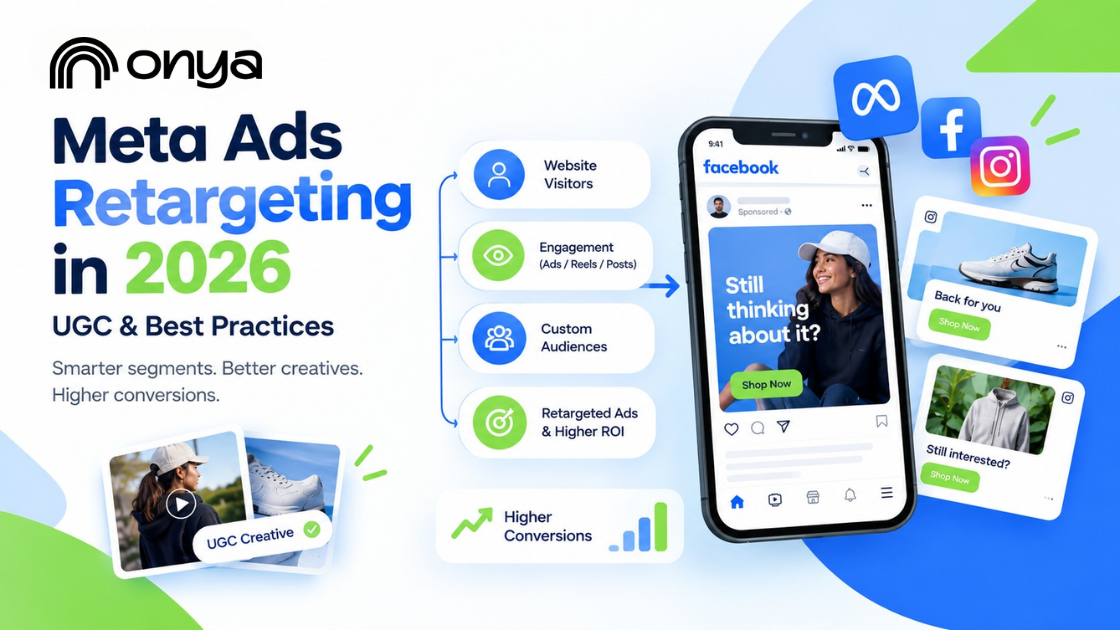
How to optimize UGC for meta ads retargeting 2026?
Meta's ad delivery system now treats creative as a relevance signal, not just the audience behind it. A repeated, generic ad loses ground even when the targeting is accurate, because the platform rewards ads that actually resolve something for the specific person seeing them. That's a meaningful shift from how retargeting used to work, and most campaigns haven't caught up to it yet.
At Onya, we manage Meta retargeting across higher education, healthcare, and business clients, and the gap we see most often isn't a budget problem or a platform problem. It's a strategy problem. The same ad running to every past visitor, with no consideration for where that person actually stopped engaging, is where most retargeting spend goes quiet.
This post breaks down what makes Meta ads retargeting work in 2026, from how to segment your audiences correctly to which creative approach fits which stage of the funnel and how to read your results honestly.
Why the Same Retargeting Ad Twice Doesn't Work Anymore
Meta's delivery system reads fatigue in real time. Run the same creative to the same person too many times, and the platform doesn't just get less effective; it actively deprioritizes the ad. Costs climb. Relevance drops. You end up paying more to reach people who already told you, by not converting, that the first version didn't land.
A few signs this is happening in your account:
Frequency is past 4-5x with no lift in clicks or conversions.
CPMs are creeping up on an audience that hasn't grown.
The same creative has run 30+ days with no rotation.
One ad is going to everyone who visited, regardless of how far they got.
None of this means Meta ad retargeting stopped working. It simply means the strategy behind it hasn't kept up. Retargeting still earns its spot in the funnel — but only when the creative and audience logic change with the person seeing it, not when an ad gets built once and left to run.
How Retargeting with Facebook Ads Works
Meta ad retargeting relies on one core piece of infrastructure: the Meta Pixel, a snippet of code on your website that tracks visitor activity and reports it back to Meta. Without it, you can't build an audience from your website activity.
Here's the sequence:
Someone visits your site or engages on Facebook or Instagram.
The Pixel logs that action and sends it to Meta.
Meta matches it to a user profile.
Your campaign serves ads to that person next time they're in-feed.
Pixel-only setups are common but increasingly incomplete. Browser blockers and iOS privacy settings mean a chunk of signal never makes it through. Pairing the pixel with the Conversions API closes that gap, since server-side data doesn't rely on the visitor's browser cooperating.
If you're still deciding where to put ad spend in the first place, this breakdown of Google Ads vs Meta Ads covers how the two platforms differ.
How Retargeting Instagram Ads Works
Instagram retargeting uses engagement and website activity to reconnect with people who have already interacted with your brand. Instead of relying only on broad audience targeting, you can build audiences from actions people take across Instagram, Facebook, and your website.
Here’s the basic sequence:
Someone watches your Reel, interacts with a post, visits your profile, or lands on your website.
Meta receives signals from that interaction through its platform and tracking tools.
Those signals can be used to create or update a retargeting audience.
Your Instagram campaign then delivers relevant ads to people who match your audience criteria.
For example, someone might watch a large portion of a product Reel but leave without visiting your website. You can create an audience around that type of engagement and show them a follow-up ad with more product information or a different creative.
Website visitors can also be retargeted on Instagram when the appropriate Meta tracking and audience setup is in place. The Meta Pixel can send website events to Meta, while the Conversions API can complement browser-based tracking with server-side event data.
The key is to treat Instagram retargeting as a continuation of the customer's first interaction, not simply another opportunity to display the same ad. Someone who watched a Reel, visited a product page, or abandoned a cart may need a different message at each stage.
That makes audience segmentation and creative rotation just as important as the retargeting campaign itself.
Build Retargeting Audiences Around Behavior, Not Channel
Most accounts build one audience: everyone who visited in the last 30 days. That treats a person who reads one page the same as someone who almost converted, and they need completely different ads. Group your audiences by what the person actually did, not which channel they came from:
Engagement-based — visited your site or watched most of a video, but took no further action. They know you exist; they're not sold yet.
Intent-based — started something and didn't finish: an abandoned cart, an unfinished application. This is your highest-intent group; they've told you exactly what they want.
Relationship-based — people you already have data on, email lists, and past customers. Worth prioritizing since first-party data holds up better as tracking degrades, part of why retargeting still earns its place in 2026.
Each group stalled for a different reason, so each needs a different message. That's what makes the next step, matching UGC retargeting ads to the right hook, actually work.
Match the Hook to the Reason They Stalled
The product doesn't need three versions. The first three seconds do. Someone who barely looked needs a different opener than someone who almost bought, and matching that opener to the actual hesitation is what separates UGC that converts from UGC that just adds frequency.
Awareness Hook: For Visitors Who Left Too Early They saw the ad or landed on the site but never connected it to a problem they actually have. The fix isn't a better product shot; it's leading with the problem itself, in plain language, before the product ever shows up. If the hook doesn't name what they're struggling with, the product looks irrelevant no matter how good it is.
Proof Hook: For Visitors Who Hesitated Cart abandoners clicked, then talked themselves out of it. Usually it's one unanswered objection: will this actually work for someone like me? Answer it with something concrete, not a general claim:
A specific timeframe ("after two weeks")
A specific result, not a vague one
An unpolished, real moment over a staged one
Decision Hook: For Visitors Who Are Almost Ready This is someone deep in consideration, not a past buyer. They've viewed pricing, come back more than once, and maybe started a form or cart and stopped. They don't need convincing anymore; they need a reason to stop deliberating: a deadline, a guarantee, or a direct answer to what's still holding them back.
Rotate the opener before the offer. When frequency climbs and results dip, the hook usually goes stale first, not the product or the price.
Meta Ads Retargeting Best Practices: How Often to Refresh UGC Creative?
The same clip that converted well two weeks ago starts losing steam the moment your audience has seen it too many times, and leaving it running past that point burns the budget instead of saving it.
Watch performance, not the calendar. Two numbers tell you when it's time to replace a creative:
Frequency past roughly 3-5x with no lift in clicks or conversions
CTR declining on a specific asset, not just the campaign average
When both start moving the wrong way, replace the creative, usually every 2-3 weeks for an active retargeting segment, sooner for smaller audiences that see the same ad more often.
Refreshing doesn't always mean a full reshoot. Often the fastest fix is swapping the opening hook or format on existing footage. If you're running low on raw material to pull from, this breakdown of UGC content ideas is a good next stop before you schedule a new shoot.
Formatting UGC for Facebook and Instagram Retargeting
A strong hook still underperforms if the format looks like an ad instead of a Reel. A few non-negotiables for retargeting social media content on Facebook and Instagram:
A few things worth getting right:
Shoot vertical, 9:16, for Stories and Reels, where most retargeting inventory runs
Front-load the hook; the first two to three seconds decide whether someone stays.
Burn in captions, since most Feed and Stories viewing happens with sound off
Skip the polish; handheld framing and natural lighting read as authentic, which matters more with a warm audience than production value
Facebook and Instagram audiences don't always respond the same way. With retargeting Instagram ads, you'll often see more visual, lifestyle-driven clips perform best, campus life, and product-in-use moments.
When retargeting with Facebook ads, you're often reaching an older or more decision-adjacent audience, parents in a higher-ed context, for example, so slightly more direct, information-forward creative can perform better there. Running the same UGC on both, with small adjustments to pacing or caption tone, tends to outperform picking one platform and skipping the other.
These aren't universal retargeting ads best practices; they're specific to warm audiences who've already seen your brand once and are deciding whether the second look is worth their time.
Are Your UGC Retargeting Ads Actually Working?
Vanity metrics won't tell you if it's actually paying off. Check these at the individual-asset level, not the campaign average:
Frequency and CTR trend per asset — a declining CTR on one specific clip is your earliest fatigue signal, well before overall cost per result moves.
Cost per result by audience segment — lumping every stalled visitor into one report hides which segment is actually underperforming.
Performance by platform — retargeting with Facebook ads and retargeting Instagram ads rarely perform identically, so review them separately.
If none of this is tracked at that level, the honest answer is, "You don't know whether retargeting is working; you just know it's running.
This is usually where teams either build the reporting themselves or bring in someone who already has the system for it. At Onya, matching hooks to funnel stage, formatting for each platform, and reporting on individual assets isn't an add-on; it's the default way we run Meta ads retargeting for every client, higher education, ecommerce, or otherwise.
Conclusion
Retargeting on social media only works when the strategy behind it does. Segment audiences by behavior, match each hook to the reason someone stalled, and refresh creative before fatigue sets in — that's what separates UGC retargeting ads that convert from ones that just add frequency. This discipline applies whether you're running retargeting with Facebook ads, retargeting Instagram ads, or both at once.
Onya is a full-service digital marketing agency that builds this whole system: strategy, creative, platform-specific formatting, and asset-level reporting, not just the retargeting piece. If you want a team that follows retargeting ads best practices end to end, see what Onya can do for your business. Contact us now!
Frequently Asked Questions (FAQs)
What counts as UGC in a Meta retargeting ad? Content that looks like it's from a real person, not a brand. Think testimonials, honest reviews, or day-in-the-life clips.
How is retargeting different from a regular Meta ad? Regular ads target people who don't know you yet. Retargeting shows ads only to people who already visited or engaged with your brand.
Can the same UGC clip work on Facebook and Instagram? Yes, but results differ. Instagram favors lifestyle content, Facebook often does better with more direct messaging.
Do I need a big budget for UGC retargeting ads? No. Polished, expensive-looking ads often perform worse with a warm audience than something that looks real.
How do I know if my UGC creative needs to be replaced? Watch frequency and CTR on that specific ad. When frequency rises and CTR drops, it's time to swap it.
It appears that the recent decline in your social media reach may not be a coincidence. The digital landscape is evolving (maybe a bit too quickly), and the once free-exposure platforms are now becoming increasingly monetized.
The algorithms governing these platforms are undergoing significant changes, presenting new challenges for organizations and content creators alike.
One notable development is Meta's (formerly Facebook) introduction of paid subscription tiers for businesses, aptly named "Meta Verified Business Tiers". These tiers are designed to cater to a "wider range of business needs," as stated by Meta.
However, this initiative raises concerns about the potential commodification of exposure and reach on the platform.
The Meta Verified Business Tiers: A New Pay-to-Play Model
Meta's new subscription tiers are as follows:
Business Plus: Momentum ($45/month)
Business Premium: Engagement ($120/month)
Business Max: Optimization ($350/month)
The higher the tier, the more features and exposure businesses can expect, including profile enhancements, feed features, and limited support.
Essentially, businesses will now have to pay a premium for visibility and support on the platform, a stark contrast from the previously free exposure model.
Initially, these tiers are being rolled out in Australia, New Zealand, and Canada, with plans for expansion to other regions in the future. Eligibility for these tiers is determined by various factors, including business platform activity, and volume of consumer interaction (profile visits, post engagement, and message conversations), among others.
Implications for Businesses and Content Creators
This shift towards a pay-to-play model presents several implications for businesses and content creators:
1. Paying for reach does not guarantee quality engagement
While organizations may be able to purchase increased reach through these tiers, it does not necessarily translate into meaningful engagement or conversions. Organic content creation and strategic campaigns remain crucial for nurturing authentic connections with the target audience.
2. Reevaluating social media strategies
Businesses may need to reevaluate their social media strategies and allocate budgets accordingly if they wish to maintain or enhance their visibility on Meta's platforms. However, it is essential to avoid solely relying on paid reach and neglecting organic content creation efforts.
3. Potential democratization of exposure
While the monetization of reach may seem concerning, it could also level the playing field for smaller businesses and content creators who previously struggled to gain traction on these platforms due to algorithmic biases or established competition.
The Way Forward: Prioritizing Authentic Engagement
As Meta introduces these changes, for businesses and content creators remaining vigilant is crucial. They should avoid getting lured by quick-fix solutions or "shiny shortcuts."
While it may be tempting to simply pay for increased reach, doing so without a solid content strategy and authentic engagement efforts could lead to inflated vanity metrics without meaningful impact.
Instead, the focus should remain on creating high-quality, engaging content that resonates with the target audience. Prioritizing human behavior and fostering genuine connections with consumers should be the primary goal, rather than solely relying on paid reach.
It is important to remember that businesses and content creators are the driving force behind Meta's platforms. Without their active participation and content creation, the platforms would lose their value and relevance. As such, businesses and creators hold significant power in shaping the direction of these platforms through their collective actions and choices.
While Meta's move towards monetizing reach may seem like an attempt to emulate traditional marketing models, where content exposure is directly linked to advertising costs, it is crucial to recognize the unique dynamics of the digital landscape. The true value lies in cultivating authentic connections and fostering meaningful engagement, rather than solely relying on paid exposure.
Let this be our opportunity to use our power against monopolistic decisions like theirs. For no other reason than because we deserve to have a voice, make connections, and build communities - free of charge. This might be a spicy take, but we’d love to hear your thoughts. Reach out to Onya today to learn more about this update!
YouTube Shorts Gets Serious About Advertising With New Premium Placement Options
YouTube continues doubling down on its competitors by rolling out new premium advertising placements for the short-form video platform with YouTube Shorts. The new ad offerings allow businesses and creators to purchase prominent ad placements within the Shorts feed, opening up more monetization opportunities.
As Shorts rapidly gains popularity, eclipsing 70 billion daily views, YouTube is aiming to turn it into a more viable revenue stream.
According to MediaScience, YouTube Select Shorts ads are viewed for 90% longer than ads on other social competitors.
Let's take a closer look at what these new premium ad placements entail and whether they're worth investing in for organizations.
The Premium Placement Options
YouTube is introducing three new premium ad products specifically for Shorts:
Shorts Bumper Machine-Learned Bidding Ads
These are 6-second bumper ads that play at the beginning of a Shorts video. Advertisers can use machine learning to optimize ad delivery to audiences most likely to pay attention and take action.
Shorts Video Ads
Advertisers can run standard video ads up to 30 seconds long that play before a Shorts video. This emulates traditional pre-roll YouTube ads.
Shorts Call-to-Action Overlays
These are banners or overlays that appear at the bottom 20% of a Shorts video, with customizable calls-to-action like app installs, site visits, etc.
All three ad formats are purchased through an auction in Google Ads and use app campaign optimization to drive engagement.
Key Benefits and Drawbacks
For organizations, these premium placements on YouTube Shorts present some compelling benefits:
Reaching the Shorts Audience: With over 1.5 billion monthly logged-in users watching Shorts, it's a massive and engaged audience, especially among younger demographics.
Premium Placement: Being able to purchase top ad spots guarantees premium placement within the Shorts feed instead of fighting the algorithm.
Action-Oriented Ads: The overlay ads with clear calls-to-action could drive valuable engagement for campaigns focused on downloads, traffic, etc.
However, there are also some potential drawbacks and risks:
Cost and Competition: Like any premium placement, the bidding environment on Shorts will be competitive and likely expensive for guaranteed top visibility.
Audience Attention: Although brief, forced ads could disrupt the seamless viewing experience that makes Shorts engaging, causing viewers to skip quickly.
Ad Load: YouTube will have to carefully balance ad load on Shorts to avoid driving viewers away with too many disruptive commercials.
Is It Worth the Investment?
Ultimately, whether these new YouTube Shorts premium ad placements are worth investing in depends heavily on an organization's goals, audiences, and budgets.
For businesses laser-focused on a TikTok/Gen Z demographic, Shorts ads seem like a potential must-have. The overlay call-to-action ads could also excel for mobile user acquisition campaigns.
However, companies working with limited advertising budgets may find the cost of premium Shorts placements too restrictive. The audience attention and ad load challenges also make guaranteed view metrics crucial for judging real ad effectiveness and ROI.
As with any new ad product, a wait-and-see approach evaluating the initial results for early Shorts advertisers could inform better long-term investment decisions.
Overall, YouTube Shorts' first stab at premium ad inventory presents exciting but unproven potential. As the platform and monetization evolve, organizations should monitor Shorts' development as both a viewing phenomenon and an emerging ad channel. If you want to learn more about this possible advertising tactic on social media, be sure to reach out to Onya today!
As Onya knows and discusses often, social media has become a crucial part of marketing and engaging with customers for most organizations.
However, too often brands get bogged down in trying to be overly promotional or corporate sounding on social platforms. They forget that social media is supposed to be social. Injecting some fun and personality can go a long way.
We understand there is a level of professionalism and “buttoned-upness” that you have to share when it comes to the voice of your business. You don’t want to treat it like your trip to the mall. But there needs to be some level of enjoyment with social media sharing.
Below, we explain why it matters to loosen up a bit and have fun!
Why Fun Content Matters
Entertaining and engaging content resonates with people much more than dry corporate speak. Studies have proven that fun content is viewed as more memorable and engaging than dull, run-of-the-mill messaging. Countless companies have shown the value of taking a fun, playful approach on social channels.
Wendy's frequently roasts other brands in a humorous way, like when they tweeted "Where's the beef??" at McDonalds after the rival launched a disappointing new burger. This sassy and fun interaction generated huge engagement.
Merriam-Webster's Twitter feed is delightfully quirky and unexpected at times for a dictionary brand.
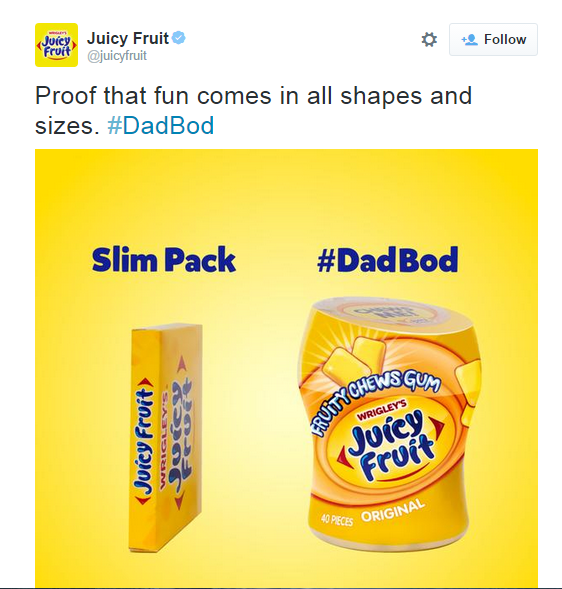
Juicy Fruit jumped on the ‘Dad Bod’ phenomenon to create this clever ad that features their different types of gum packs. They found a subtle yet humorous way to incorporate a hot trend into their brand content.
Having Fun Drives Engagement
Beyond being memorable, fun content generates much higher engagement rates. An analysis found that brands that used GIFs earned 55% more engagement than brands that didn't. Visuals, humor, interesting formatting and takes on current events or trends tend to drive much higher likes, shares, comments, and clicks.
This extends to paid social ads as well. According to Sprout Social, ads that were funnier and more playful with their creatives saw an increase in traffic and conversions versus more serious, sterile ads.
Tips for Making Social Fun
So how can brands embrace a lighter, more entertaining approach on social? Here are some tips:
Post funny memes, GIFs, and videos (within good taste)
Share jokes, puns, and amusing anecdotes related to your industry
Get creative with hashtags, tweet formats, and filters
Run silly polls and quizzes
Respond to customer questions in a witty, on-brand way
Join in on trending topics or hashtag games
Behind-the-scenes bloopers and outtakes
Share funny customer stories or interactions
Creative user-generated content contests
The key is letting your brand's unique personality shine through versus just pushing ads and product info. Be relatable. Comment on things customers are talking about in an insightful or funny way. Don't be afraid to be playful.
At the same time, of course, brands need to strike a balance. While having fun is important, it shouldn't come at the expense of your broader marketing goals or cross ethical lines. Keep it light and positive without being offensive or inappropriate.
The brands that win on social are the ones that view it as a two-way conversation with customers. They use it as a platform to engage and entertain just as much as to inform and promote. By finding ways to have more fun and personality, you'll see much higher social media engagement and affinity for your brand.
If you are looking to find ways to integrate more humor into your content to lighten the mood, reach out to Onya today!
The Rise of AI Integrated Features on Social Media
While many of us are using Artificial Intelligence (AI) chatbots to ask silly questions and generate ridiculous images in our spare time, AI is rapidly being integrated into many of the social media platforms and apps used every day. Major players like Twitter, Instagram, TikTok, and Snapchat have all caught on to the intriguing trend and rolled out new AI-powered tools and features over the past year...showing no signs of slowing down as AI capabilities continue advancing.
What does this mean for us?
Below, we share what features platforms are leveraging and how your organization can take part in the shifting social media sphere.
Who’s Using AI and What For?
Twitter was one of the first to embrace AI with features like automatic caption writing for images and predictive text suggestions when composing tweets.
Instagram quickly followed suit by integrating similar AI caption generators, AI-powered filters and effects, and editing features.
TikTok's supportive AI capabilities now include automated video editing tools.
Finally, Snapchat has AI-driven cameo selfies that can superimpose your face onto videos.
This AI integration provides some compelling benefits for social media users. One is that AI captioning can make content more accessible for those with disabilities (Real-time captioning or translations for people with a hearing impairment or even people who don’t speak the language).
Predictive text can also help get ideas flowing while drafting posts. Even if it doesn’t produce the entire draft, it provides suggestions to move past writer's block and move forward without stopping. AI editing tools can elevate the production quality of videos and photos by cutting and merging content with ease, giving your precious time back.
However, there are also valid concerns about AI's potential downsides like perpetuating biases, spreading misinformation, and compromising privacy. There have already been a few instances in which organizations have had their wrists slapped for perpetuating poorly constructed content that could have been unbiased in their stance.
Where Does This Leave You?
AI is powerful and can cut writing/editing/posting time significantly. However, for organizations looking to leverage AI on their social channels (appropriately), here are some key recommendations:
1. Prioritize transparency about AI usage and get user consent when appropriate.
Be open about what AI capabilities are being utilized. This means citing resources and noting that some content was generated by AI. This ensures you are being transparent about your content and forthcoming about where ideas started.
2. Implement robust testing to identify and mitigate risks like biases being baked into AI models before deploying publicly.
This means you have to read...actually read and vet what AI is spitting out there. Validate that facts are correct and ensure unfair and unfruitful bias is removed where possible.
3. Have a clear AI governance framework outlining principles for ethical and responsible AI development aligned with your brand values.
This can vary based on your organization and some compliance departments. If AI is acceptable, be sure to outline where to draw the line. If there already is a line, follow it.
4. Focus AI efforts on areas that tangibly benefit your audience like accessibility, content personalization, and productivity optimizations.
Again, AI is incredible in cutting down time. But it can’t come at the cost of poor content. Users and readers can catch robotic content and if they sense it’s going to become a trend for you, they may navigate elsewhere to original and unique ideas. AI may be helpful, but it does not replace our creative minds.
5. Continuously monitor AI outputs and be prepared to make adjustments as AI models evolve and new risks emerge over time.
Like with any new technology, it doesn’t work to push it away with all your might. Work alongside AI to understand and leverage it wherever possible, but as always, keep your target audience in mind and what their needs may be.
When applied thoughtfully with proper safeguards, AI can enhance the social media experience for users and open creative possibilities for organizations. A shortsighted "AI at all costs" approach is bound to backfire. Responsible adoption with human supervision is key for harnessing AI's potential in society.
If you want to understand more about Onya’s policies when it comes to AI or how your organization should respond, we would love to chat more. Contact us today!
Social media is the land of the free and the home of the trendy. While jumping on the bandwagon may seem like fun and games, there are several common pitfalls that folks should steer clear of if they want their organization to remain strong online.
Below, we will discuss these social media issues and why it might be best to avoid them when posting online.
#1 Buying Fake Likes & Followers
One of the most tempting shortcuts is purchasing likes and followers to inflate one's popularity. However, this practice is not only unethical but also ineffective in the long run. Research shows that fake followers do not engage with content, leading to a skewed engagement rate that can damage credibility and hinder genuine audience growth.
#2 Using Special Fonts and Hashtags in Your Bio
While using unique fonts and hashtags in your bio may seem like a way to stand out, it can actually make your profile look unprofessional and cluttered. Studies indicate that users prefer clear and concise bios that convey essential information about the account or brand. Overly stylized bios may distract from your message and deter potential followers. Keep it simple and keep it short.
#3 Not Taking Time to Respond to Comments and Interact with Your Community
Social media is inherently social, and failing to engage with your audience can alienate them. Buffer suggests that prompt responses to comments and messages foster a sense of community and trust among followers. Neglecting this aspect of social media can result in missed opportunities for meaningful connections and customer relationship management.
#4 Not Making Your Account a Positive Online Space
Unfortunately, online negativity abounds, which means maintaining a positive and inclusive environment on social media is crucial. Studies have shown that positive content elicits higher levels of engagement and fosters a loyal audience. Conversely, negativity can drive followers away and tarnish your brand's reputation. By curating uplifting and inspiring content, you can cultivate a supportive community around your brand.
#5 Focusing on Likes Instead of Engagement and Conversions
While likes may serve as a vanity metric, they are not indicative of meaningful engagement or conversions. Seek to focus instead on building genuine relationships with your audience that drive actionable outcomes, such as clicks, shares, and purchases. This will yield more significant long-term benefits for your brand.
#6 Jumping on Every Trend, Even If It Doesn't Align with Your Organization:
While capitalizing on trending topics can increase visibility, jumping on every trend without considering its relevance to your brand can come across as inauthentic. Studies have shown that authenticity is a key factor in consumer purchasing decisions, and aligning with unrelated trends may confuse or alienate your audience.
#7 Oversharing Personal Information
Social media blurs the line between personal and professional, but oversharing personal details, especially on organizational accounts (or those intended for professional purposes) can have negative consequences. Research suggests that oversharing can lead to privacy concerns and diminish the perceived professionalism of your brand. Striking a balance between authenticity and discretion is essential for maintaining a positive online image.
#8 Inconsistent Branding
Consistency is key to establishing a strong presence on social media. We’ve seen it time and time again that cohesive branding across platforms increases brand recognition and trust among consumers. Inconsistencies in tone, aesthetics, or messaging can dilute your organization's identity and confuse followers.
#9 Ignoring Negative Feedback
Negative feedback is inevitable on social media, but ignoring it can exacerbate the situation. Online reviews indicate that addressing negative feedback promptly and transparently can turn detractors into advocates and demonstrate your commitment to customer satisfaction. Ignoring negative feedback, on the other hand, can damage your reputation and erode trust in your brand.
#10 Automated DMs
Automated direct messages may seem like a convenient way to engage with followers, but they often come across as impersonal and spammy. Onya has seen that personalized interactions are more effective in building rapport and fostering meaningful connections with your audience. Automated DMs can alienate followers and detract from your brand's authenticity if not managed properly.
If your organization is serious about digital success, it’s important to weave in a combination of authenticity, engagement, Tactics and strategic planning.
By avoiding these ten social media cringes, you can build a genuine online presence, foster meaningful connections with your audience, and ultimately achieve your goals effectively. Remember, authenticity and integrity are the cornerstones of a successful social media strategy.
Looking for more help when it comes to building online relationships that matter for the long haul? Onya is here to help. Reach out today to learn more!
Spring is in full swing as people are once again out and about and….definitely searching for things in their local vicinity.
You know it well because, well, you do it yourself all the time.
Whether it’s for a local tourist trying to find the next best wine bar or a local homeowner needing some HVAC repairs, your organization must be found online.
But how do you make that happen?
As we embark on our 2024 growth journey, Onya is here to guide you through the latest strategies and techniques to boost your organization's local rankings. Follow this comprehensive guide to ensure your business stands out in local search results and attracts the right audience.
Why Local Rankings Are Important
Local rankings are extremely important for the success of your business, as they directly influence your visibility and accessibility to potential customers in your local area. According to a study by Moz, 93% of local searches trigger the Google Local Pack, highlighting the significance of local rankings in search engine results.
When your organization ranks high locally, it ensures that it appears prominently when nearby users search for relevant products or services, increasing the likelihood of attracting customers and outperforming competitors. This heightened visibility not only establishes trust and credibility but also drives foot traffic to physical locations, giving long-term business growth that becomes sustainable over time.
Here’s How You Can Optimize Your Organization Locally
Optimize Google My Business (GMB) Profile:
Ensure your GMB profile is complete and accurate with up-to-date information, including business hours, address, and contact details.
Utilize GMB features such as posts, reviews, and Q&A to engage with your local audience.
Regularly update images, ensuring they showcase your business in the best light.
Local Keyword Optimization:
Conduct thorough keyword research focusing on local terms and phrases relevant to your industry.
Integrate these keywords naturally into your website content, meta descriptions, and headers.
Optimize location-based landing pages to target specific geographic areas.
Online Reviews Management:
Encourage satisfied customers to leave positive reviews on platforms like Google, Yelp, and industry-specific review sites.
Respond promptly to both positive and negative reviews, showcasing your commitment to customer satisfaction.
Leverage positive reviews on your website and marketing materials.
Mobile Optimization:
With the increasing prevalence of mobile searches, ensure your website is mobile-friendly and responsive.
Optimize loading speed to enhance the user experience, as slow-loading sites can negatively impact local rankings.
Local Link Building:
Build relationships with local businesses and organizations to secure high-quality backlinks.
Participate in local events, sponsorships, or partnerships that can lead to valuable mentions and links.
Ensure consistency in NAP (Name, Address, Phone Number) across all online platforms.
Content Localization:
Create content that is tailored to your local audience, addressing their specific needs and concerns.
Include location-specific information, such as local events, news, and community involvement.
Develop location-specific landing pages for different service areas.
Social Media Presence:
Maintain an active and engaging presence on social media platforms, particularly those popular among your local audience.
Share local events, promotions, and community initiatives to connect with your target market.
Incorporate schema markup on your website to provide se arch engines with structured data about your business.
Include local business schema to enhance your chances of appearing in local search results.
Regular Local SEO Audits:
Conduct regular audits of your local SEO efforts to identify areas for improvement.
Monitor local keyword rankings, check for consistency in NAP, and analyze the effectiveness of your local link-building strategies.
By implementing these strategies, your organization can make big waves in people’s local search and find you effectively.
The digital marketing experts at Onya are here to guide you every step of the way, ensuring your business thrives in local rankings and continues to attract and retain valuable customers. Here's to a successful and locally optimized 2024!
The Power of Account-Based Marketing for Your Organization
One interesting trend that’s been catching Onya’s eye lately? Account-Based Marketing (ABM)!
This new area in marketing has emerged as a game-changer for organizations looking to foster meaningful connections with their target audience, especially when dangling bait for larger groups hasn’t gained any traction. This personalized and targeted approach has gained a TON of popularity for its ability to drive engagement, increase revenue, and strengthen relationships.
What is Account-Based Marketing (ABM)?
Account-Based Marketing is a strategic approach that aligns marketing and sales efforts to focus on a specific set of high-value target accounts. Unlike traditional mass marketing, ABM is a more personalized and targeted method, tailoring marketing campaigns to resonate with the unique needs and characteristics of individual accounts.
The Shift Towards Personalization
We work in a field where consumers are bombarded with generic marketing messages. This means that personalization has to become the key differentiator. According to a study by Evergage, 88% of marketers reported a measurable lift in their business results from personalization, showcasing the impact of tailoring messages to specific audiences.
Account-Based Marketing takes personalization to the next level by honing in on individual accounts, understanding their pain points, and delivering highly relevant content and experiences. This shift from a broad approach to a more nuanced, account-specific one creates a deeper connection with prospects and clients.
The Importance of ABM in B2B Environments
For organizations operating in the B2B realm, the significance of Account-Based Marketing cannot be overstated. ABM is especially effective in industries where the sales cycle is complex, and the decision-making process involves multiple stakeholders. By focusing on a select group of high-potential accounts, businesses can allocate resources more efficiently and increase the likelihood of closing high-value deals.
Driving ROI with ABM
One of the most compelling reasons we believe organizations need to leverage Account-Based Marketing is its impressive return on investment (ROI). According to a survey conducted by Alterra Group, 97% of marketers reported that ABM had a higher ROI compared to other marketing initiatives. This statistic underscores the effectiveness of personalized, targeted approaches in driving tangible results.
Strengthening Client Relationships
Beyond driving revenue, Account-Based Marketing plays a pivotal role in strengthening client relationships. By understanding the unique challenges and goals of individual accounts, organizations can tailor their interactions to provide value and demonstrate a genuine commitment to their clients' success. This personalized approach fosters trust and loyalty, laying the foundation for long-term partnerships.
How Does Account-Based Marketing Work?
Identifying Target Accounts:
ABM begins with the identification of high-potential target accounts. These accounts are selected based on criteria such as revenue potential, strategic importance, or niche industry verticals.
Understanding Account Needs:
Once the target accounts are identified, a deep understanding of their needs, pain points, and goals is crucial. This often involves thorough research and engagement with key people in those groups.
Personalized Content and Campaigns:
ABM involves creating highly personalized content and campaigns specifically designed for each target account. This could include tailored messaging, customized advertisements, and personalized outreach.
Multi-Channel Engagement:
ABM follows a multi-channel approach, integrating various marketing channels such as email, social media, content marketing, and even personalized events. This approach ensures that target accounts are reached across the varying touchpoints.
Alignment with Sales Teams:
Close collaboration between marketing and sales teams is crucial for the success of ABM. Both teams have to work together for the messaging and efforts to be aligned, fostering a seamless transition from marketing engagement to the sales process.
Measuring and Analyzing Results:
Metrics and KPIs are established to measure the success of ABM campaigns. This could include metrics like engagement rates, conversion rates, and overall revenue generated from the targeted accounts.
Iterative Refinement:
ABM is an ever-changing process that involves constant refinement based on data and feedback. As insights are gathered from ongoing campaigns, strategies and campaigns are adjusted and optimized to enhance effectiveness.
While this might just sound like another marketing tactic, we do believe this shift in approach will make a big difference for many! Account-Based Marketing enables organizations to forge deeper connections with their most valuable accounts, drive revenue, and enhance client relationships. As the marketing landscape continues to evolve, embracing the power of ABM is not just a choice but a strategic opportunity for you to thrive in the modern business environment. If ABM is something you’d like to learn more about, Onya is here to help. Reach out today to learn more!
Building Automation into Social Media Tools—Wise or Risky?
Keeping up with a demanding social media posting schedule is both necessary but can be quite stressful (been there, done that). We know we need to provide content but at what cost? Like many these days, the question has shifted to, “Should we leverage automation?”
With the growing demands of maintaining a strong online presence, the debate over the wisdom of integrating automation into social media tools has become a hot topic. Below, we dive into the pros, cons, and considerations surrounding the strategic decision to automate your social media activities.
The Pros: Unlocking Efficiency and Consistency
Time Efficiency:
Automation streamlines repetitive tasks, saving you valuable time. Scheduling posts, responding to comments, and engaging with your audience can be practically automated, allowing you to focus on higher-level strategies and organizational growth.
Consistency in Presence:
Maintaining a consistent online presence is crucial for social media success. Automation ensures your content is shared at optimal times, even when you're not actively managing your profiles, leading to a more reliable brand presence when your target users want and use it the most!
Data-Driven Insights:
Many automation tools provide analytics that offer valuable insights into your audience's behavior. This data helps refine your strategy, making your social media efforts more effective over time.
The Cons: The Human Touch Dilemma
Risk of Inauthenticity:
Over-automation can lead to a lack of authenticity and sounding a bit robotic. Users crave genuine interactions, and excessive automation might result in stale responses that turn away potential followers or customers.
Algorithmic Challenges:
Social media algorithms are always updating and changing, each and every day. Relying solely on automation may make it challenging to adapt to sudden changes in algorithms or take advantage of new trends (and frankly, could break some expected posts from showing).
Limited Personalization:
Automation tools, while efficient, often lack the personal touch that can make a significant impact. Crafting personalized responses to comments or messages is a human strength that automation struggles to replicate.
How to Strike the Right Balance
Balancing Automation and Human Engagement:
The key lies in finding the right balance. While automation can handle routine tasks, human engagement is best for building meaningful connections. Use automation to free up time for actual, genuine interactions.
Regular Audits and Adjustments:
Social media trends and algorithms change rapidly. Regularly audit your automation strategy to ensure it aligns with the current landscape and be prepared to make adjustments based on real-time data.
Ethical Use of Automation:
Avoid automating activities that may be perceived as unethical or insincere. Authenticity should always be a priority, and automation should enhance, not detract from, the human touch in social media interactions.
Building automation into your toolkit can be a wise move when approached strategically. By harnessing the efficiency and insights automation offers while preserving the authenticity of human interaction, you can create a powerful synergy that propels your social media presence to new heights.
The key is to be mindful and adaptive and to always prioritize the genuine connections that make social media a truly impactful platform. If authenticity is what you crave but support is lacking, reach out to Onya today to see how we can help!
One Hour a Day to SkyRocket Your Following on Instagram
“That’s a full-time job”
We hear it all the time as a reason people can’t grow on a platform like Instagram. We will never say growing on Instagram is easy. It takes effort and a plan to execute.
But it CAN be done in one hour a day.
Here are some of the ways our clients get more done in less time with better results:
#1 They don’t scroll for inspiration for hours on end.
Research shows that excessive time spent on social media, especially aimlessly scrolling for inspiration, can lead to a decrease in productivity. By limiting inspiration-seeking activities, users can focus on creating meaningful content during their dedicated hours.
#2 They focus on creating content that actually produces growth.
The Instagram algorithm favors consistent and engaging content. Users who concentrate on creating content that resonates with their audience and aligns with trending topics or relevant hashtags are more likely to gain visibility and attract new followers.
#3 They automate comments and story engagement so they don’t have to do it all manually.
Social media automation tools have become popular for managing engagement without spending excessive time manually responding to comments and engaging with stories. By automating these processes, users can maintain a consistent presence and save time for more strategic activities.
#4 They use a proven framework so they know exactly what to do and aren’t constantly wondering if it’s correct.
Studies on productivity emphasize the importance of having a structured approach to tasks. A proven framework provides a step-by-step guide, reducing uncertainty and decision fatigue. It also eliminates guesswork and guides your actions in that crucial one-hour window. Whether it's a content calendar, posting schedule, or a set routine for engagement, having a framework in place ensures that your efforts are intentional and geared toward growth.
#5 They have an ideal buyer blueprint that allows them to always know what to say in the caption to attract people with the problem they solve.
Knowing your target audience and tailoring content to their interests is crucial for social media success. Research indicates that personalized and relatable captions perform much better than those that are more generic. An ideal buyer blueprint that aligns with your target audience strategy (talk to us more about this!) helps users understand their audience's pain points, enabling them to craft captions that resonate and attract individuals facing similar challenges.
But what does that one hour look like?
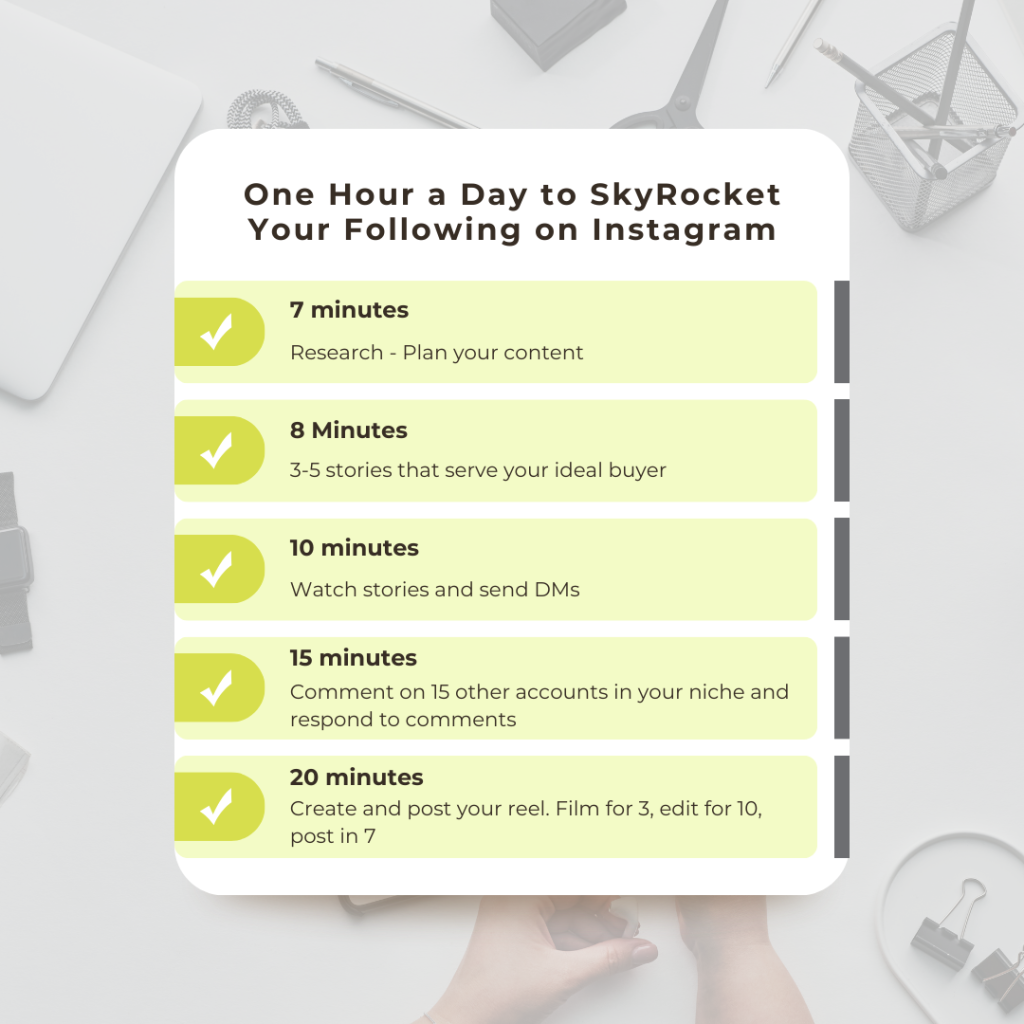
Let’s start low and move up. Here is a recommended possible time frame to get your one-hour-a-day bang for your buck:
7 minutes: Research - Plan your content
8 Minutes: 3-5 stories that serve your ideal buyer
10 minutes: Watch stories and send DMs
15 minutes: Comment on 15 other accounts in your niche and respond to comments
20 minutes: Create and post your reel. Film for 3, edit for 10, post in 7
In just one focused hour a day, you have the power to revolutionize your Instagram strategy. By prioritizing content creation, embracing automation, and following a proven framework, you'll witness a very tangible and impressive increase in your follower count!
Needing some guidance on a proven framework you can count on to make the most of your valuable time? Reach out to Onya today to learn more!